On cellular aging and the 12 hallmarks
The word energy has been thoroughly colonised by wellness marketing, by manifesting culture, by every brand that has ever put a woman in white linen standing in morning. It had become a vessel for everything and therefore a container for nothing. So when I was introduced to Nutrilite AmCELL — drawn in by the literature on cellular energy and biological age — I put the brochure down and went to the science first.
The Framework
There is a framework in longevity research called the Hallmarks of Ageing. It was first formalised by López-Otín and colleagues in 2013, then expanded to twelve hallmarks in a landmark 2023 paper in Cell. What it describes is not ageing as entropy — the slow winding-down we tend to imagine — but ageing as a set of specific, identifiable biological processes occurring at the cellular level. Each one measurable. Each one theoretically addressable.
The twelve include genomic instability and telomere attrition (the structural architecture of the cell degrading), epigenetic alterations (the instructions the cell reads becoming corrupted), loss of proteostasis (the cell's protein quality control failing), disabled macroautophagy (the cellular self-cleaning mechanism going offline), deregulated nutrient-sensing (the cell losing calibration for energy use), mitochondrial dysfunction (the power infrastructure flickering), cellular senescence — what researchers call zombie cells, cells that have stopped dividing but haven't cleared, leaking inflammatory signals into surrounding tissue — stem cell exhaustion, altered intercellular communication, chronic inflammation, and dysbiosis.
Read that list slowly. What you are reading is not abstract laboratory language. It is a precise description of how anyone past thirty-five feels when the depletion arrives and the usual explanations stop accounting for it.
The Product
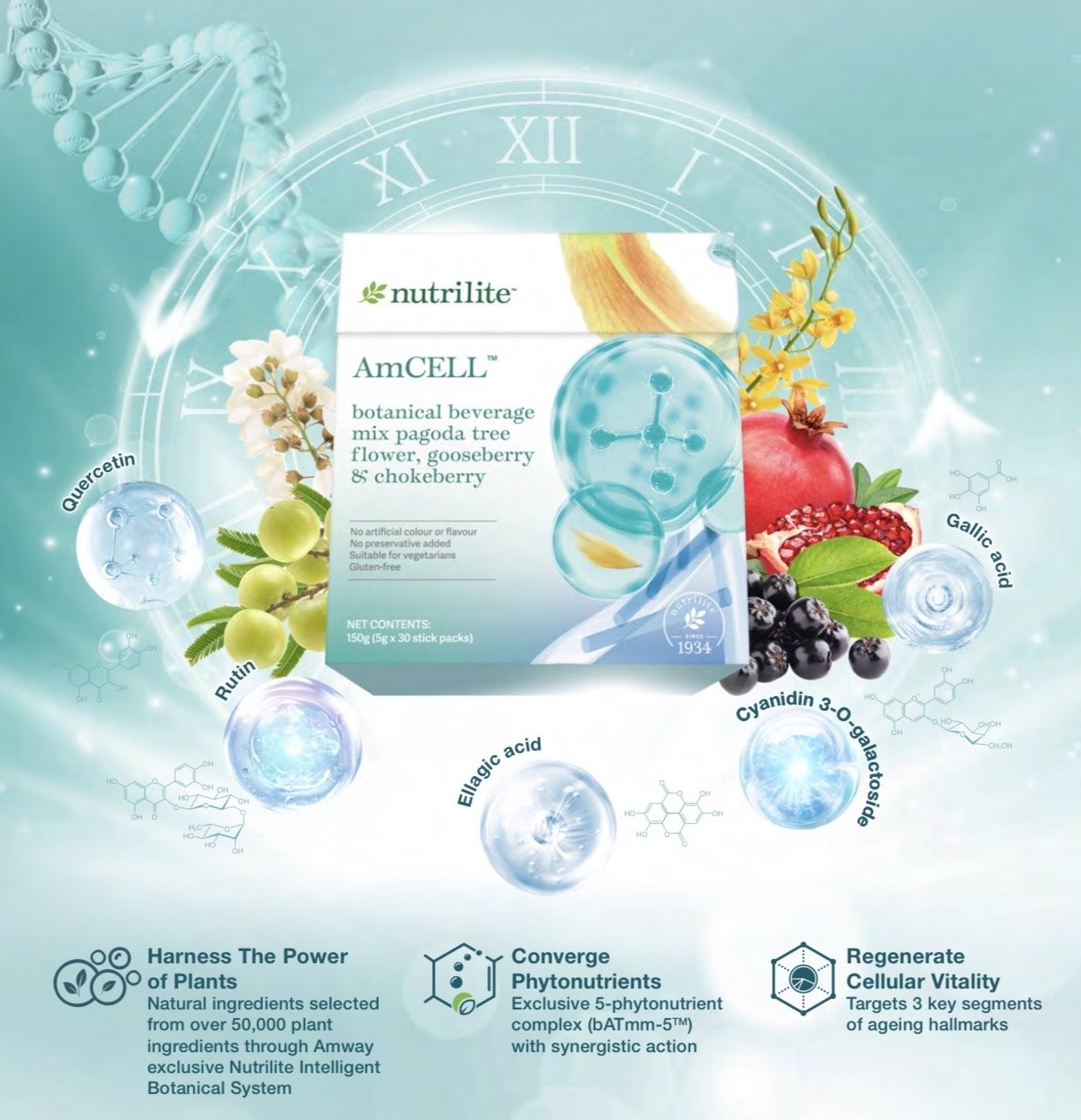
AmCELL is built on a five-phytonutrient complex called the Golden Regeneration Combination — bATmm-5. The five compounds are quercetin, rutin, gallic acid, ellagic acid, and cyanidin 3-O-galactoside, sourced from five plants: Pagoda Tree Flower, Dendrobium Orchid, Gooseberry from Yunnan, Pomegranate from California, and Chokeberry from Poland. Each plant was selected through the Nutrilite Intelligent Botanical System, screening over 600 plant types and 50,000 ingredients. This is not a supplement that threw popular antioxidants at a label. The sourcing has lineage.
What the five compounds do collectively maps onto the three major segments of the hallmarks framework. Gallic acid and rutin address the cellular microenvironment — reducing chronic inflammation, the slow systemic fire that turns zombie cells from a nuisance into a crisis. Cyanidin 3-O-galactoside and ellagic acid stabilise cellular structure — supporting DNA repair at the genomic level. Quercetin targets cellular function — regulating mitochondrial activity, the energy infrastructure itself.
The research on rutin is interesting. It does not kill zombie cells. It quiets them — dampening the inflammatory secretions that make cellular senescence so destructive to surrounding tissue. This is called senomorphic action, and it is a more sophisticated intervention than simple antioxidant support. Quercetin's documented effects include reduction of intestinal senescence and improvement of microbial dysbiosis — the gut-inflammation axis that functional medicine practitioners have been tracking for years, now appearing in mainstream longevity literature.
None of this means AmCELL will reverse your biological age in thirty days. What it means is that the ingredient rationale is coherent, grounded in the same framework that serious longevity researchers are using, and not assembled by marketing alone. One note for those who work with practitioners or run regular bloodwork: as a botanical food-matrix blend, AmCELL does not publish exact compound concentrations. The active molecules are present and the sourcing is traceable, but the formulation sits in a different category from dose-verified pharmaceutical-grade supplements. Worth knowing, not worth dismissing.
The Provenance
Nutrilite has an eighty-year history of what I would call regenerative production — one of very few supplement brands in the world to grow, harvest, and process botanical ingredients on its own certified organic farms, maintaining seed-to-supplement traceability across the full production chain. For ingredients sourced beyond their own farms, a certification programme governs partner growers across twenty-seven countries, requiring zero synthetic pesticides, herbicides, or fertilisers. Quality control runs to over 25,000 tests per month and half a million evaluations per year. Every ingredient undergoes a comprehensive safety assessment drawing on the FDA, WHO, Health Canada, and the US Pharmacopeia. Independent third-party certification — including annual facility inspections — is standard practice, not a marketing claim.
AmCELL is an Asia-developed product, with ingredients like the Yunnan Gooseberry and Dendrobium Orchid sourced specifically from the Asia-Pacific botanical heritage and developed through Nutrilite's regional research programme. People in my professional network have visited the production and quality control facilities and come away satisfied — not by marketing materials, but by the actual processes: the handling protocols, the testing infrastructure, the agricultural practices on the ground. One of those who visited assessed the facility not only through a conventional quality lens but with attention to what I can only describe as the energetic integrity of the process — the intention embedded in how things are grown and made. They found it clean, in every sense of the word.
What I Observed
I took it for sixty days. One stick pack dissolved in water each morning for the first month; two packs daily through the second, which is a dosing progression I have since learned is common among practitioners working with it more intensively.
I work within a whole-system framework — the Total Load Concept — in which cellular health is one terrain among many, and supplements are support, not salvation. I was also moving through an unusually high-pressure period during these two months, which is worth naming because it is the condition under which the results surprised me most.
The first thing I noticed was the absence of the mid-afternoon depletion — the 3pm drop I had been managing with various combinations of hydration, light exposure, and protein — stopped arriving with the same insistence. Not gone entirely. Less like a wall and more like a gradient. I noticed this before I connected it to AmCELL.
The second thing was pigmentation. I have post-inflammatory hyperpigmentation that has been stable for years, neither worsening nor improving significantly. After approximately six weeks I noticed lightening in two patches I had mentally filed as permanent. The mechanism would be consistent with the ellagic acid research, which has documented melanin inhibition effects. More broadly, a skin radiance shift — not the dramatic before-and-after of topical treatments, but a quality of luminosity that reads as cellular rather than surface — is the most consistently reported observation across users I have spoken to and accounts I have read. It maps cleanly onto what reduced oxidative stress and improved cellular turnover would produce. I hold it as data, not conclusion.
The third thing was stress resilience — the quality of my recovery between high-demand periods. What I noticed was that I returned to baseline faster than I expected to, given the load I was carrying.
A fourth observation, which I flag with caution because it is not something I can personally verify: several users report improved mental clarity — sharper focus, less cognitive fog, a steadiness of attention that had been missing. I cannot claim this for myself with the same confidence as the other three observations, but it is mechanistically plausible. Mitochondrial dysfunction and chronic neuroinflammation are both documented contributors to cognitive fog; both sit within the hallmarks framework that AmCELL addresses. If this is a real signal in the user population, the mechanism exists to explain it.
What Others Observed
Two observations from a colleague's client network are worth including — not as proof, but as data points consistent with the mechanism.
A post-partum client had experienced significant hair loss following birth, the kind of diffuse shedding that accompanies the body's hormonal recalibration in the fourth trimester. Taking two sticks daily from October 2025, she saw visible regrowth along the parting line by April 2026 — six months in, hair healthier and noticeably fuller. Post-partum hair loss is a systemic response to resource reallocation; the hair follicle is one of the first non-essential systems to be rationed when the body is under load. A supplement addressing cellular energy terrain and inflammation at the root level is, mechanistically, a plausible support for follicle function.
A second user, on her second box, reported a noticeable reduction in white hair. The connection between cellular senescence, oxidative stress, and melanocyte function is documented — greying is increasingly understood as a cellular ageing process, not merely a genetic inevitability.
Both: observation, not claim.
Before You Take It: Who Should Check First
Part of responsible curation is saying clearly when something is not for everyone. AmCELL's active compounds — quercetin and ellagic acid in particular — are pharmacologically active, which is what makes them effective. That same activity creates meaningful interactions with certain medications and conditions. This is not a liability disclaimer. It is the information you need to make a considered decision.
Do not take without consulting your doctor if you are on any of the following:
Anticoagulants and blood thinners — including warfarin, aspirin (at therapeutic doses), and clopidogrel. Quercetin inhibits the liver enzyme responsible for metabolising warfarin, and ellagic acid compounds have demonstrated enhanced anticoagulant activity in research settings. The combined effect can push blood levels into a potentially dangerous range. This is the most significant and best-documented interaction in the literature.
Immunosuppressants — particularly cyclosporine. Quercetin interferes with drug-metabolising enzymes and membrane transport pumps in ways that can produce unpredictable changes in drug concentration, creating risk of toxicity or treatment failure.
Chemotherapy — interactions between the antioxidant compounds in AmCELL and chemotherapy agents are genuinely complex, and the research is mixed. Anyone in active oncological treatment should discuss this with their oncologist before using any polyphenol-rich supplement.
Glucose-lowering medications and insulin — including metformin, sulfonylureas, GLP-1 agonists, and insulin therapy (which includes all Type 1 diabetics). Quercetin has documented independent blood-sugar-lowering properties; combined with any agent that reduces glucose, this can produce an additive effect and risk hypoglycaemia. The concern applies regardless of diabetes type — the variable is the medication, not the diagnosis. Worth noting: quercetin is studied favourably for type 2 diabetes prevention and management in people not on medication; the concern is specifically for those already on glucose-lowering drugs or insulin.
Antihypertensives — quercetin has independent blood-pressure-lowering effects. If you are already on medication to manage blood pressure, the combination warrants monitoring.
Fluoroquinolone antibiotics — including ciprofloxacin and levofloxacin. Quercetin may alter antibiotic absorption and efficacy. A short course is unlikely to be problematic, but concurrent use during a full antibiotic treatment is worth flagging to your prescribing doctor.
And if any of the following apply:
Pregnancy or breastfeeding — there is no controlled safety data for quercetin supplementation in pregnancy or lactation. Avoid.
Pre-existing kidney disease — at normal doses this is a low-risk category, but high-dose polyphenol supplementation has shown potential for renal stress in acute toxicology studies. Those with compromised kidney function should seek medical guidance before adding any concentrated polyphenol supplement to their protocol.
For healthy adults not on the medications above, AmCELL at the recommended single-stick daily dose sits within a well-tolerated range. The compounds are present in the foods we eat — pomegranate, berries, green vegetables — at concentrations that do not trigger these interactions. The supplement concentrates them, which is the point, and which also warrants the care above.
The Recommendation
Who this is for: Anyone navigating unexplained fatigue, poor stress recovery, or depletion that does not respond proportionally to rest — particularly from the mid-thirties onward when cellular decline begins to compound. Anyone doing the work — food, sleep, movement, stress management — and finding the returns diminishing. Anyone curious about biological age as distinct from chronological age, and willing to take a longer view than a two-week cleanse.
What it is not: A substitute for addressing upstream conditions — the sleep debt, the dietary patterns, the nervous system dysregulation, the toxic load — that determine whether cellular interventions have terrain to work with. AmCELL is cellular support. Not a total system reset. It also does not address every hallmark equally — NAD+ decline, deep senolytic clearance, and mitochondrial membrane targeting are territories where other tools do more specific work. The distinction matters, and so does the stack.
The format: Thirty stick packs per box. The standard starting dose is one per day in water; some practitioners work with two to three daily for more intensive protocols. No artificial colour or flavour, no preservatives, suitable for vegetarians, gluten-free. The taste is mild, slightly fruity, unremarkable in the best possible way — it does not taste like medicine and it does not taste like a wellness performance.
One practical note on timing: take it in the morning or early afternoon — it may well help with the mid-afternoon slump, which is part of the point. I once had a pack at around 5pm following an unexpectedly draining few hours and found myself revived well into the evening — alert, writing, nowhere near ready for sleep when I had expected to be. A pleasant surprise in that instance, but not a pattern to build a sleep-supportive evening around.
AmCELL is, to my knowledge, the first mass-market supplement built explicitly to address the 12 Hallmarks of Ageing framework. That is a significant step forward from the antioxidant-and-collagen paradigm that has dominated supplementation for two decades. The science is coherent. The provenance is clean. My experience corroborated both.
I will keep taking it.
How to Get It
AmCELL is available directly from me.
SGD 165 per box (30 sticks). Payment via PayNow. Delivery within Singapore arranged on confirmation.
This is not a paid review. I purchase my own supply.
Filed under: Cellular Health · Longevity · Supplementation